.png)
China’s Demographic Transition: How Changing Lifestyles Are Reshaping Global Mobility

Across the world, lifestyles are evolving. Younger generations are taking more time to build their careers, explore international opportunities, and prioritize balance between professional ambitions and personal life.These shifts — driven by mobility, education, and changing aspirations — are gradually transforming demographic patterns on a global scale.
China illustrates this transition particularly clearly today.
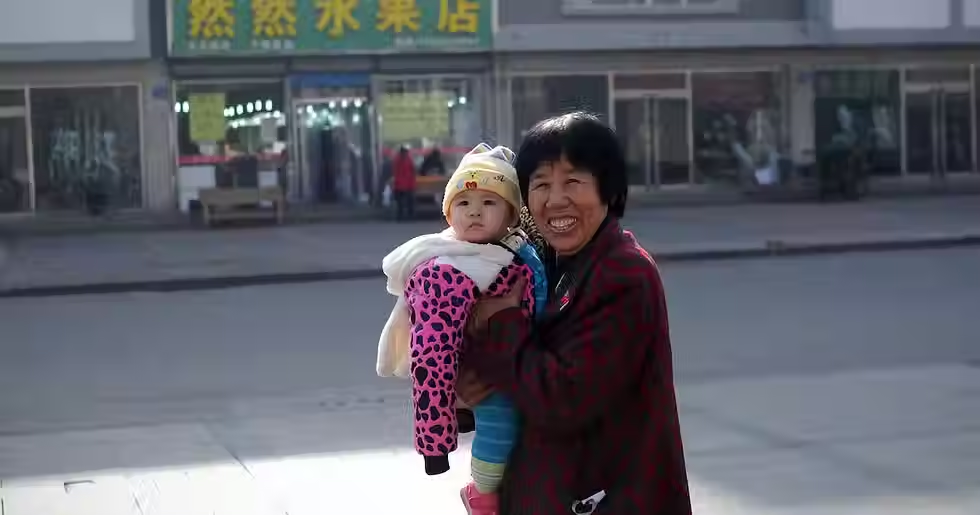
A Demographic Shift in China
In 2025, China recorded around 7.9 million births, compared to nearly 18.8 million in 2016. In less than a decade, the annual number of births has therefore fallen by more than half.
The birth rate now stands at approximately 5.6 births per 1,000 inhabitants, one of the lowest levels ever observed in the country. At the same time, the number of deaths exceeds the number of births, resulting in a slight population decline for the fourth consecutive year.
These figures reflect a long-term transformation rather than a sudden change — one shaped by economic development, urbanization, education levels, and evolving expectations around work and family life.
Changing Priorities, Changing Life Paths
China’s demographic evolution mirrors trends visible in many advanced economies.
Young professionals are increasingly choosing to:
invest more time in education and career development,
gain international experience before settling down,
prioritize flexibility, mobility, and quality of life.
Life paths are becoming less linear. Traditional milestones are often postponed or redefined, replaced by more diverse and personalized trajectories shaped by global opportunities.
What This Means for Global Mobility
As populations age and birth rates decline, many countries are adapting to these shifts by becoming more open to international talent.This evolution is reshaping global mobility in several ways:
Growing demand for skilled foreign professionals
Increased focus on flexible housing, education, and family-oriented services
Greater importance placed on structured relocation and mobility support
For individuals, these changes open new possibilities to live and work abroad.For organizations, they reinforce the need to attract, retain, and support talent across borders.
A Broader Global Transition
China’s demographic transition is not an isolated case. Similar patterns can be observed across Europe and other parts of Asia, highlighting a broader global shift in how people approach work, family, and long-term life choices.
Rather than signaling decline, these trends reflect societies adapting to new realities — where mobility, personal fulfilment, and international experience play an increasingly central role.
As demographic dynamics continue to evolve, global mobility is becoming not just a response to economic needs, but a defining feature of modern lifestyles.
Comments