.png)
THE ROLE OF HEALTHCARE IN SUCCESSFUL RELOCATION

A strategic lens on relocation, not just a practical one
In international mobility, healthcare is often treated as a practical matter to be addressed once the move is already underway. In reality, it should be considered much earlier, as part of the broader conditions that shape assignment quality and long-term settlement success. For assignees and their families, access to healthcare is closely linked to confidence, continuity and peace of mind. For employers and mobility teams, it also touches on duty of care, employee experience and the overall sustainability of an international move.
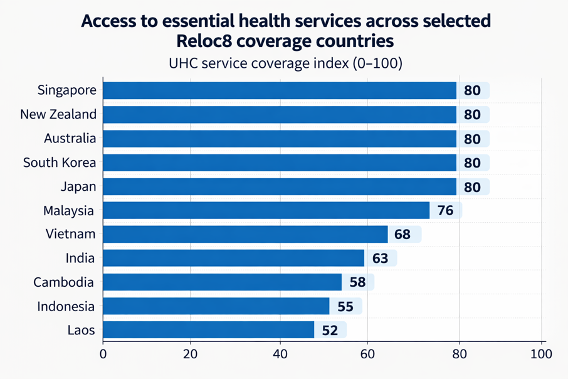
This is especially relevant in Asia-Pacific, where regional growth and business dynamism often coexist with very different local healthcare realities. A single regional label can suggest coherence, yet healthcare access remains highly uneven across markets. To illustrate that variation, the chart below uses the UHC service coverage index, the indicator used by the World Health Organization and the World Bank to track coverage of essential health services. The index is reported on a 0 to 100 scale, with higher scores indicating stronger overall service coverage. It is a composite measure built from 14 tracer indicators covering reproductive, maternal, newborn and child health, infectious diseases, noncommunicable diseases, and service capacity and access. The WHO also notes that it is an indicator of service coverage, not a full measure of the entire healthcare experience or of affordability on its own.
What the chart tells us about relocation environments
The value of this comparison lies less in ranking countries than in highlighting how different the relocation context can be from one destination to another.
Where UHC service coverage is stronger, assignees may be entering a healthcare environment that appears more structured and potentially easier to understand at a system level. Where scores are lower, the practical experience of relocation may require more preparation, more explanation and, in some cases, greater reliance on private providers or more careful local orientation. The chart therefore works as a reminder that “moving within Asia-Pacific” is not one standard experience. It can mean entering very different conditions of access, reassurance and day-to-day predictability depending on the destination. This interpretation is an inference from the WHO/World Bank service coverage framework and from the spread of scores shown in the comparison.
For mobility professionals, this matters because relocation is never judged solely on whether the process was completed. It is also judged on how confidently the employee and family are able to live in the new location afterwards. A move can be efficient on paper — immigration completed, housing secured, schooling arranged — while still feeling operationally fragile if healthcare pathways remain unclear. In practice, uncertainty around how to access care, who to contact, which providers are suitable, and what financial implications may arise can become a major source of stress during the first months of settlement.
Why healthcare belongs in the duty-of-care conversation
Healthcare is therefore not simply a “benefits” topic or an emergency issue. It sits within a wider duty-of-care framework. The World Bank defines universal health coverage as ensuring that people can obtain the health services they need without suffering financial hardship, which is precisely why service coverage needs to be interpreted alongside the broader question of financial protection. In relocation terms, this means that access is not only about whether services exist, but also about whether assignees can understand the system, use it appropriately and feel protected enough to rely on it when needed.
This is where the business dimension becomes more explicit. When employees and families feel reassured about healthcare access, they are generally in a stronger position to focus on adaptation, performance and daily stability. When they do not, healthcare can quickly become a hidden pressure point within the assignment. This is particularly true for accompanied moves, senior hires, longer-term postings and relocations involving unfamiliar healthcare systems. In that sense, healthcare contributes to the broader quality of the employee experience and should be understood as one of the operational foundations of successful international mobility. That link to assignment quality is an inference, but it is a grounded one given how strongly UHC is framed by the WHO and World Bank around access and financial protection.
A further practical point for mobility professionals
Another important consideration is that healthcare access is not only about whether a public system exists, but whether assignees and their families can realistically use it with confidence and ease. Across several Reloc8 markets, public healthcare may be available, but it is not always the pathway internationally mobile employees feel most comfortable using. Public facilities can involve more administrative complexity, more limited language support, and a service environment that feels less familiar to international families. As a result, many assignees rely in practice on private hospitals or international clinics for greater comfort, clarity and predictability.
Vietnam illustrates this particularly well. Foreign employees may contribute to the mandatory social and health insurance framework, which supports access to public healthcare, but many still require private health insurance alongside it in order to use private or international-standard clinics more easily. Similar dynamics can be seen in other destinations across the region: public healthcare may exist, but eligibility rules, reimbursement structures, provider choice, waiting times, language barriers or patient experience often mean that private cover remains an essential complement in practice.
For mobility professionals, the implication is clear: healthcare planning should not stop at confirming that a destination has hospitals or formal coverage mechanisms. The more relevant question is whether assignees will be able to access care in a way that feels understandable, reassuring and operationally workable from day one. In that sense, private insurance, local guidance and early expectation-setting often become key parts of successful relocation support.
How Reloc8 can make the difference more manageable
For Reloc8, the relevance of this topic is clear. The role of a relocation partner is not to replace medical professionals, insurers or healthcare advisers. It is to reduce uncertainty and help clients better understand the local environment in which employees and families will be settling. In markets where healthcare systems, access routes and local practices can differ significantly, that local insight becomes part of the practical value of relocation support.
This means helping assignees approach their destination with a clearer view of local realities, helping employers anticipate where more explanation may be needed, and supporting a smoother transition into day-to-day life. The chart reinforces exactly that point: across the countries covered by Reloc8 and its regional network, healthcare access cannot be assumed to function in the same way everywhere. The more varied the environment, the greater the importance of informed local guidance. In that sense, healthcare is not peripheral to relocation; it is one of the factors that helps determine whether a move feels merely completed, or genuinely successful.


Comments